Gluten-Free Flourless Chocolate Cake Is Richer Than You'd Guess
Most cakes rely on flour to hold everything together. Take the flour out and you'd expect the whole thing to fall apart. Flourless chocolate cake does the opposite. Without any flour at all, it turns out denser, richer, and closer to a truffle than a slice of birthday cake.
That's exactly why this dessert has become such a common search across the US and Canada. It solves a problem a lot of home bakers run into. Someone in the house can't eat gluten, yet everyone still wants a real dessert at the end of dinner, not a separate, lesser version made just for one person.
This guide looks at what actually goes into a flourless chocolate cake, why it holds together without flour, and what tends to trip people up the first time they bake one. If chocolate desserts are your thing more broadly, our roundup of the best sugar-free desserts is worth a look too.
What People Search Before Baking One
A quick look at common searches shows this cake attracts a fairly specific set of questions. People type in things like:
-
Is flourless chocolate cake gluten free
-
How to keep flourless chocolate cake from cracking
-
Flourless chocolate cake without eggs
-
Best chocolate for flourless cake
-
Flourless chocolate cake vs chocolate cake
-
Gluten free chocolate cake for celiac
The pattern behind these searches is simple. People want to know the science holds up, not just the taste. A dessert this rich needs to actually be safe for the person who can't eat gluten, and it needs to hold its shape once it's sliced.
Why This Cake Skips Flour Entirely
Flour usually does two jobs in a cake. It adds structure, and it soaks up moisture so the batter isn't too wet to bake. A flourless chocolate cake replaces both of those jobs with different ingredients.
Eggs carry the structure. Whipped eggs trap air, and that air is what gives the cake its lift and hold, since there's no gluten network doing that work instead.
Melted chocolate and butter provide the body. Together, they set as the cake cools, giving it that dense, almost fudge-like center that this dessert is known for.
Cocoa powder deepens the flavor without adding any of the starch that regular flour would bring.
Because the recipe leans on so few ingredients, the quality of each one matters more than usual. A cake built from six ingredients has nowhere for a weak one to hide.
Is It Actually Safe for Celiac Disease?
This is the single biggest concern behind most of the searches around this cake, and the honest answer is: it depends on the kitchen, not just the recipe.
The core ingredients, eggs, chocolate, butter, sugar, and cocoa powder, contain no gluten on their own. The risk usually comes from two places instead:
-
Cross-contamination. If the same kitchen tools or surfaces recently touched wheat flour.
-
Chocolate that isn't verified gluten free. Some brands process chocolate on shared equipment with wheat-based products.
For someone with celiac disease rather than a general sensitivity, checking that the chocolate itself carries a gluten-free label matters more than most people expect. It's an easy detail to overlook when every other ingredient looks obviously safe.
Who Reaches for This Dessert Most Often
People managing celiac disease or gluten sensitivity
A cake built entirely without flour removes the guesswork that comes with flour substitutes, which can vary quite a bit in texture and reliability from one brand to the next.
Hosts serving a mixed group
Rather than baking two desserts, one regular and one gluten free, this cake works as the single dessert for a table where dietary needs differ from guest to guest.
Anyone who prefers a denser, richer texture
Not everyone avoiding gluten. Plenty of people simply prefer this cake's fudgy, almost molten center over a lighter, fluffier slice.
Home bakers short on time
With so few ingredients and no need to fold in dry components carefully, this cake comes together faster than most layered desserts
Making a Batch Without the Guesswork
You don't need advanced technique for this cake, though a bit of care with technique goes a long way. A general approach looks like this:
-
Melt good chocolate and butter together slowly, using low heat so neither one scorches.
-
Whisk eggs on their own until they turn pale and roughly double in volume.
-
Fold the warm chocolate mixture into the whipped eggs in small additions, keeping the motion gentle.
-
Sift in the cocoa powder last, folding just until no streaks remain.
-
Pour the batter into a lined pan and smooth the top.
-
Bake at a moderate temperature, watching closely near the end rather than relying only on the timer.
-
Let the cake cool fully before slicing, since it firms up as it sits.
Most of the work here is patience rather than skill. Rushing any one of these steps is usually where things go wrong.
Common Mistakes Worth Avoiding
A handful of small missteps show up again and again in this cake. Watch out for these:
-
Baking it too long. This cake is meant to look slightly underdone in the center when it comes out. It keeps cooking as it cools.
-
Using low-quality chocolate. Since chocolate carries most of the flavor here, a weaker bar leaves the whole cake tasting flat.
-
Skipping the parchment paper. Without flour, this batter sticks aggressively to a bare pan.
-
Cutting into it while warm. The texture needs time to set. A slice taken too early tends to fall apart on the plate.
-
Not checking the chocolate label. For anyone with celiac disease specifically, this step matters more than any other in the whole recipe.
Flourless Chocolate Cake vs Regular Chocolate Cake
|
Regular Chocolate Cake |
Flourless Chocolate Cake |
|
|
Contains gluten |
Yes, from wheat flour |
No |
|
Texture |
Light and fluffy |
Dense and fudgy |
|
Main structure ingredient |
Flour |
Whipped eggs |
|
Typical ingredient count |
8 to 12 |
5 to 6 |
|
Best served |
Room temperature |
Room temperature or slightly chilled |
Neither version is better across the board. The choice usually comes down to dietary needs and which texture someone actually prefers on the fork.
Choosing the Right Chocolate for This Cake
Since chocolate does so much of the heavy lifting here, picking the right bar changes the final result more than almost any other decision.
-
Look for chocolate labeled 60 to 70 percent cocoa for a balance between richness and sweetness.
-
Check the label for a gluten-free certification if the cake is being made for someone with celiac disease.
-
Avoid chocolate chips meant for baking, since they're formulated to hold their shape rather than melt smoothly.
-
Choose a bar you'd be happy eating on its own, since the flavor carries through directly into the finished slice.
For more on sourcing chocolate that holds up well in desserts like this, our piece on sugar-free chocolate that nobody will guess is sugar-free covers options worth trying if reducing sugar matters too.
Why This Cake Became a Restaurant Favorite
Flourless chocolate cake didn't start out as a gluten-free solution. It became a fixture on fine dining menus decades ago, mostly because of how it looks and behaves on a plate. A thin slice, dense and dark, plated with a single quenelle of cream, reads as elegant in a way a fluffy layer cake rarely does.
Its gluten-free status turned out to be a happy accident that only grew more valuable as awareness of celiac disease and gluten sensitivity increased across the US and Canada. Restaurants that already had this cake on the menu for its looks and texture suddenly found themselves offering one of the few desserts nearly every guest at a table could actually order.
That history explains why this cake still carries a slightly upscale reputation, even when it's baked at home on a weeknight. It was never designed as a substitute for something else. It was built to stand on its own, which is part of why it still feels like a real dessert rather than an accommodation.
Flavor Variations Worth Trying
A classic version of this cake is already rich enough to satisfy most cravings, but a few small changes can shift the flavor without touching the basic method:
-
Espresso powder. A small spoonful dissolved into the melted chocolate deepens the flavor without adding a noticeable coffee taste.
-
Orange zest. Freshly grated zest folded into the batter pairs naturally with dark chocolate.
-
Sea salt. A light sprinkle on top just before serving makes the chocolate flavor stand out more sharply.
-
Chili powder. A small pinch adds warmth in the background rather than heat up front, echoing traditional Mexican chocolate.
-
Almond extract. A few drops in place of vanilla give the cake a slightly nuttier undertone.
None of these changes require adjusting the core method. They simply layer a new note onto a cake that's already built to carry bold flavor well.
Serving and Topping Ideas
A plain slice of this cake already stands on its own, but a few additions round it out nicely:
-
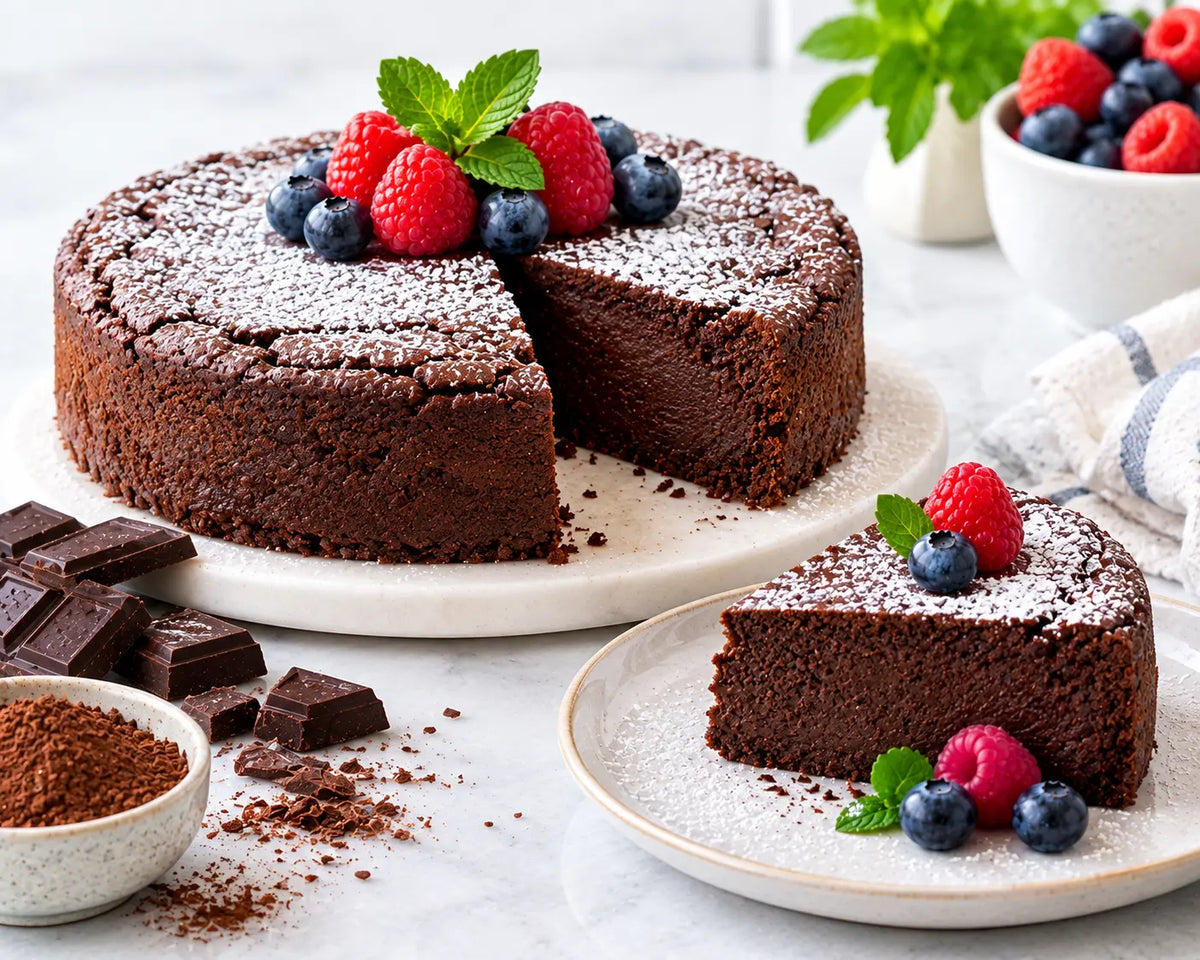
A dusting of cocoa powder or powdered sugar across the top
-
A dollop of freshly whipped cream alongside each slice
-
Fresh raspberries or strawberries for a tart contrast
-
A drizzle of warm chocolate ganache for an even richer finish
-
A scoop of vanilla ice cream, since the cake's density pairs well with something cold

Storing Leftovers the Right Way
This cake actually keeps quite well, often improving slightly after a day in the fridge. A few habits help maintain the texture:
-
Wrap it tightly once it's fully cooled, so the surface doesn't dry out.
-
Store it in the fridge if you're keeping it beyond a day or two.
-
Bring slices to room temperature before serving for the fullest flavor.
-
Freeze individual slices, wrapped well, if you want to keep some for later.
Where This Cake Shows Up Across the US and Canada
Flourless chocolate cake has become a fairly common sight at restaurants, bakeries, and home gatherings in both countries. A few settings where it tends to appear most:
-
Holiday dinners, where a gluten-free dessert lets one cake serve the whole table
-
Celebrations for someone managing celiac disease, since it removes the need for a separate dessert
-
Restaurant dessert menus, often labeled specifically as gluten free
-
Passover tables, since a flour-based cake wouldn't traditionally fit the occasion anyway
Ingredient sourcing looks fairly similar across both countries, though shoppers in Canada may find slightly fewer imported chocolate brands on local shelves compared to bigger US chains. Checking labels rather than assuming a familiar brand is safe remains the same advice on either side of the border.
Baking at Home vs Ordering One Ready-Made
Not everyone wants to manage a water bath or watch an oven closely for cracks. Ordering a ready-made version is a reasonable choice, and a few details are worth checking before you do:
-
A short ingredient list. A genuinely flourless recipe rarely needs more than a handful of components.
-
Clear labeling around gluten. Ideally, choose a bakery that understands cross-contamination risks rather than one that simply skips flour by coincidence.
-
Proper packaging for shipping. A dense cake like this can be sensitive to temperature swings in transit.
-
A bakery that specializes in dietary-friendly desserts. This usually means more care went into testing the recipe.
A slice from a bakery built around this kind of baking tends to hold its texture more consistently than a mass-produced version, simply because the process leaves less room for shortcuts.
Frequently Asked Questions
Is flourless chocolate cake naturally gluten free?
Yes, since the recipe never includes flour to begin with. The main risk comes from cross-contamination or from chocolate processed on shared equipment with wheat, so checking labels still matters for anyone with celiac disease.
Why does my flourless chocolate cake sink in the middle?
Some sinking is normal and expected, since the cake relies on whipped eggs rather than flour for its rise. A deep dip usually means it was slightly underbaked or cooled too quickly.
Can I make flourless chocolate cake without eggs?
It's difficult, since eggs provide most of the structure in this recipe. Some bakers substitute with aquafaba or a commercial egg replacer, though the texture usually turns out noticeably different.
What's the best chocolate to use for this cake?
A bar in the 60 to 70 percent cocoa range tends to give the best balance of richness and sweetness. Bar chocolate melts more smoothly than chocolate chips, which are made to hold their shape.
Does flourless chocolate cake need to be refrigerated?
It can sit at room temperature for a day or two, tightly wrapped. Beyond that, refrigeration helps it stay fresh longer.
Is flourless chocolate cake the same as a chocolate torte?
The two are closely related and often overlap, though a torte sometimes includes ground nuts in place of some of the eggs or chocolate. Recipes vary enough that the terms are often used interchangeably.
Can I buy gluten-free flourless chocolate cake instead of making it?
Yes, many bakeries offer a ready-made version. Checking that the chocolate used is certified gluten free is worth doing before ordering, especially for anyone with celiac disease rather than a general sensitivity.
Why is my cake dry instead of fudgy?
This usually comes down to overbaking. Pulling the cake out while the center still looks slightly underset, then letting it finish setting as it cools, is the most reliable way to keep the texture dense rather than dry.
Flourless chocolate cake earns its reputation the honest way, through a short ingredient list that leaves no room for shortcuts. Good chocolate, patient folding, and a willingness to pull it from the oven before it looks fully done are really all it takes.
For anyone building out a wider dessert table that still needs to work for gluten-free or lower-sugar guests, our guide to the best sugar-free desserts rounds out a few more options worth considering alongside this one.